
Many workers assume that earning a salary means they are not entitled to overtime, and that is one of the most common misconceptions in employment law. Unlike hourly workers, salaried employees often believe the rules simply do not apply to them. A paycheck structured as a salary does not, on its own, decide whether a worker receives overtime pay. So, do salaried employees get overtime? In many cases, yes.
The Fair Labor Standards Act (FLSA) is the federal law that sets overtime rules, and it looks at how an employee is paid and what work they actually perform, not simply their job title. Understanding how salaried employee overtime works helps you recognize when you may be owed time and a half.
Do Salaried Employees Get Overtime Under Federal Law?
Salaried employees can be eligible for overtime pay under the FLSA. The Fair Labor Standards Act sets the federal overtime rules, and the U.S. Department of Labor enforces these wage and hour protections. Whether a particular worker qualifies comes down to one distinction: exempt status versus non-exempt status. Under federal overtime law, exempt employees do not receive overtime pay, no matter how many hours they work. Non-exempt salaried employees, by contrast, are owed overtime for every hour worked beyond 40 in a workweek.
A common misconception is that the word salary settles the question. In reality, classification controls the outcome, and federal law requires employers to pay overtime to eligible workers. A salaried employee overtime question almost always becomes a question about exempt status. Under certain conditions, even well-paid salaried workers are owed overtime.
- A salary does not automatically make a worker exempt
- Exempt employees do not receive overtime pay regardless of how many hours they work
- Non-exempt salaried employees who work overtime earn it after 40 hours in a given workweek
- Classification depends on the FLSA salary basis test and duties test, not on a job title

Exempt vs. Non-Exempt Employees: What Sets the Two Apart
The FLSA divides the workforce into exempt and non-exempt employees. Non-exempt employees are protected by federal overtime rules and must receive overtime pay after 40 hours in a workweek. Exempt employees fall outside those protections. These federal rules reach most employers, including many small businesses.
To be treated as exempt, an employee must satisfy three parts of the exemption criteria at once. Meeting one or two is not enough.
- Salary basis: the employee is paid a fixed, predetermined salary
- Salary level: the salary meets the federal minimum salary threshold
- Duties: the employee performs qualifying executive, administrative, or professional work
If any one of these is missing, the worker is usually non-exempt and entitled to overtime pay.
The Salary Basis Test and Minimum Salary Requirement
The salary basis test asks whether a worker receives a guaranteed salary that is not reduced based on the quality or quantity of work performed. An employee paid this way receives the same amount each pay period, so the employee’s normal salary does not change from week to week. If pay instead rises and falls with hours or output, the salary basis test is usually not met.
There is also a salary level requirement. The federal salary threshold for exemption is $684 per week. Salaried employees earning less than $684 weekly are non-exempt and must be paid overtime, even if their duties would otherwise qualify as exempt. The threshold was $455 per week under an earlier rule before it was raised to the current level.
Meeting the salary level alone does not make an employee exempt. Job duties still determine exempt status, so the duties test has to be satisfied as well.

The Duties Test: Executive, Administrative, and Professional Roles
Even a worker paid a high salary can be non-exempt if their job duties do not qualify. The duties test categorizes exempt roles into executive, administrative, professional, and a few other specific categories. Employees must meet these specific duties tests to be exempt, and the analysis looks at real responsibilities rather than job titles.
- Executive: regularly manages the business or a department and directs the work of other employees
- Administrative: performs office or non-manual work tied to business operations and exercises independent judgment
- Professional: performs work that requires advanced knowledge or specialized education
A manager who mostly performs routine tasks, for example, may not satisfy the executive duties test and could be owed overtime even with the same title as an exempt colleague.
How Overtime Pay Is Calculated for Salaried Employees
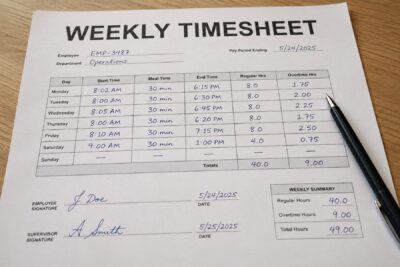
Non-exempt salaried employees are generally entitled to overtime, so the next step is to calculate overtime correctly. Overtime pay is usually calculated at time and a half, meaning one and one-half times the regular rate for each hour worked beyond 40 in a work week. The first step is converting the salary into an hourly rate, the hourly wage used to find that regular rate.
- For a steady schedule, divide the weekly salary by 40 to find the hourly wage that becomes the regular rate
- For a fluctuating schedule, divide the salary by the total hours worked that week to find the regular rate, then add half of that rate for each hour over 40
Employers must also pay at least the minimum wage when calculating these amounts, regardless of the number of hours scheduled. The regular rate per hour generally has to include certain earnings beyond base salary as well. Nondiscretionary bonuses and commissions, for instance, are often factored into the regular rate, which can change how much overtime is owed, making the regular rate central to proper wage payment.
Common Ways Salaried Employees Miss Out on Overtime
Misclassification is one of the main reasons salaried workers do not receive overtime they have earned. Some employers label a position as exempt to avoid paying overtime, even though the role does not actually meet the salary or duties requirements. An employment attorney can review how a job is classified against what the work involves.
- Being called salaried or exempt without meeting the duties test
- Earning below the federal threshold but still treated as exempt from overtime
- Holding an administrative or manager title while performing mostly routine, non-exempt tasks
Comp time is another area of confusion. Private-sector employers cannot use comp time, or compensatory time off, to avoid paying overtime to non-exempt employees. Offering future time off in place of overtime wages does not satisfy the FLSA for private employers.
State Overtime Laws and Additional Protections
Overtime protection at the federal level sets a floor, not a ceiling. State laws may provide additional protections beyond federal regulations, and some states set higher salary thresholds for overtime exemption than federal law does. When state and federal rules both apply, the standard more favorable to the employee generally governs, so a worker who appears exempt under federal law could still be entitled to overtime pay under state law. Overtime is also separate from benefits such as sick leave or paid vacation, which depend on employer policy or state law.

Understanding Your Overtime Rights
So, do salaried employees get overtime? For many workers, the honest answer is yes. Being paid a salary does not remove the right to overtime pay. What matters is whether an employee is exempt, and that depends on the salary basis test, the federal minimum salary threshold, and the duties test working together.
If you are paid a salary, work more than 40 hours, and never receive overtime, it is worth reviewing how you are classified. A misclassification can add up to significant unpaid overtime wages over time.
If you have found yourself asking, do salaried employees get overtime, you do not have to sort through the FLSA on your own.
Cantrell Schuette represents employees nationwide in unpaid overtime and wage and hour disputes, including claims involving misclassified salaried workers. If you believe you have been denied overtime pay you earned, contact Cantrell Schuette today to discuss your situation and understand your legal options.